MONG —— LEE. 李 萌

〈 停滯的月 〉
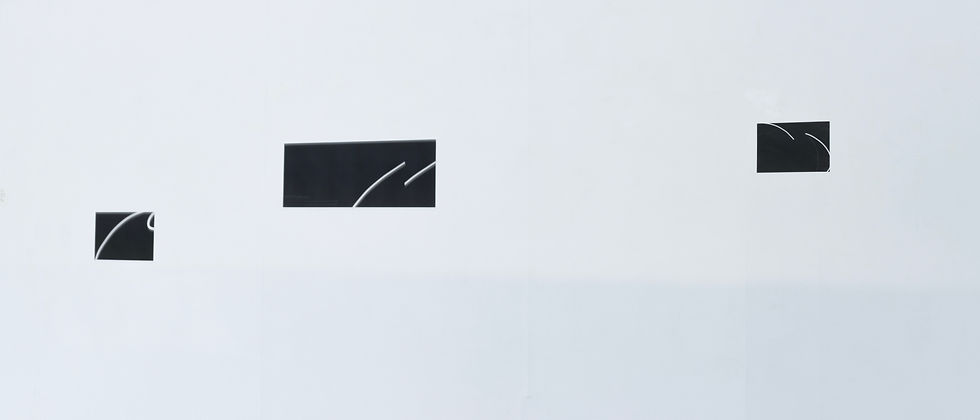
Still Moon
2025
Digital Print, Wood Board|50 x 145 cm (horizontal), 34 x 120 cm(vertical)
* 北藝大評鑑展 佳作獎 (Honorable Mention, TNUA End of semester exhibition)
Moonlight—serving as the sole light source during nighttime shooting—acts upon the camera’s mechanical sensor in conjunction with the interference of ocean waves. Through the accumulation of random factors such as defocused optics, varying shutter speeds, and repeated displacement, the resulting images extend beyond a clear field of vision, rendering location, distance, and time indistinct and blurred.
Taking the moon as the primary compositional subject, the work employs a telephoto lens in combination with multiple-exposure techniques to produce a visual perception of lunar oscillation and descent. The two-dimensional nocturnal landscape is transformed into an abstract space similar to a geometric game, while foreground elements such as clouds and waves nearly vanish from the image, receding into a suspended peripheral presence.
What is ordinarily perceived as a nearly static celestial body becomes a dynamic object, while the inherently dynamic elements of nature (clouds and waves) are rendered static. Through this divergence from the observers' everyday modes of perception, the image constructs a paradoxical composition and a dialectical relationship within the act of seeing.
月光 — 作為夜晚拍攝時的唯一的光源,與海浪的干預一同作用於機械的感光元件上,加諸鏡頭失焦、慢快門與再位移等隨機因素,影像及延伸至地點、距離、時間都模糊的視域之外。
以「月球」作為影像的構圖主體,並透過長焦鏡頭、重複曝光技法的結合使用,製造月球體晃動與下墜的視覺感知。二維平面的夜景,轉為一場有如幾何遊戲般的抽象空間,雲霧與海浪等前景則幾乎於影像中消失,轉為停滯的邊景。
原本近乎靜態的月球成為動態的物件,而動態的自然景物則轉為靜態,透過與觀者日常認知的觀看差異,使影像產生一種矛盾的構成與辯證關係。